
TypeScript Overview
📘 What is TypeScript?
(0)
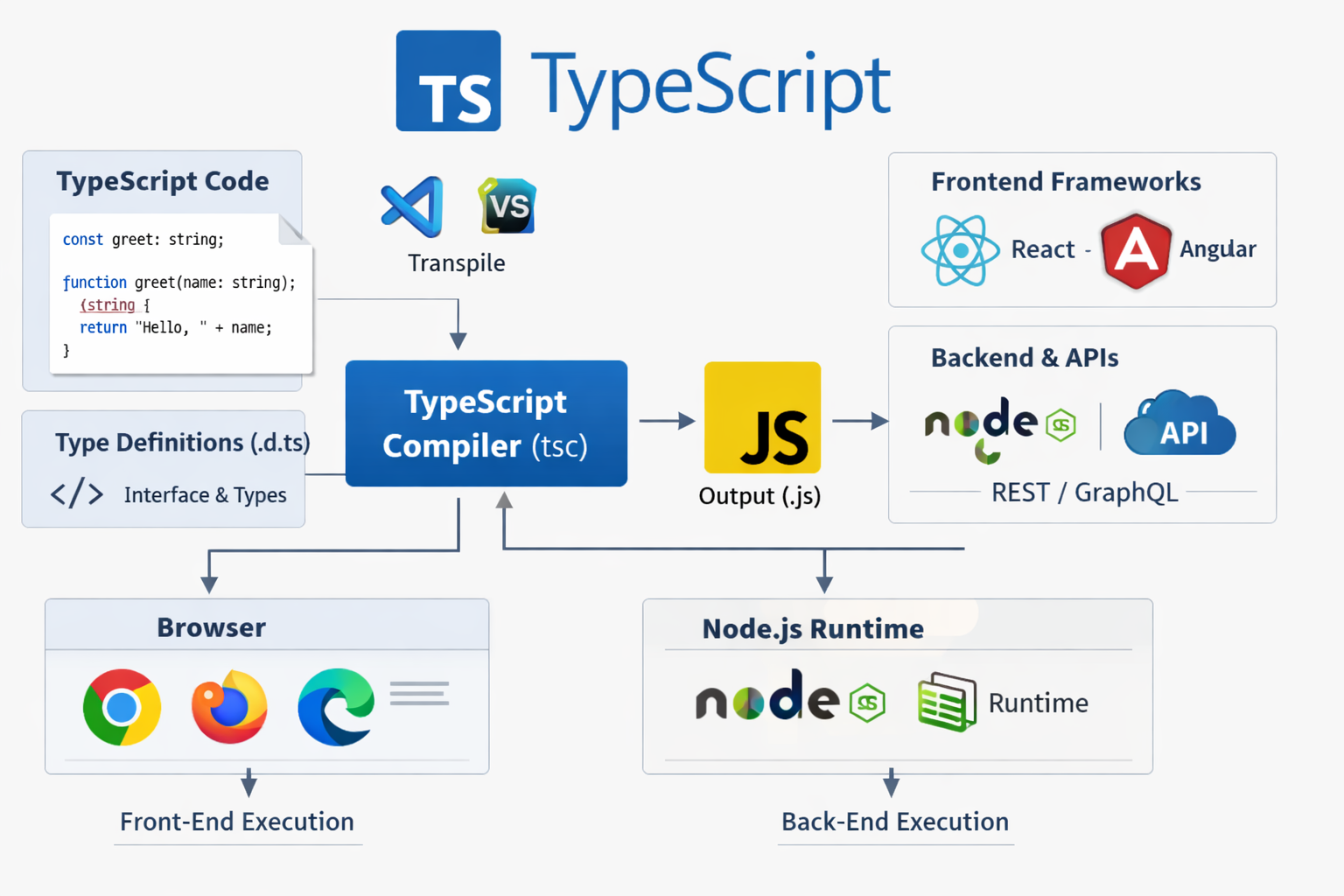
TypeScript is a superset of JavaScript developed by Microsoft. It adds static typing, interfaces, and object-oriented features to JavaScript, helping developers catch errors early and write scalable, maintainable code. TypeScript code is transpiled into plain JavaScript, ensuring compatibility with all browsers and environments.
⚡ Key Features
- Static Typing — Detects type errors before runtime
- Type Inference — Automatically infers variable types
- Interfaces & Classes — Supports OOP patterns
- Modules & Namespaces — Organizes large-scale code
- Generics — Reusable components with flexible types
- Tooling Support — Excellent IDE integration (VS Code)
❌ Disadvantages
- Requires compilation to JavaScript before running
- Learning curve for types, interfaces, and generics
- Overhead for small projects
- Integration issues with some JS libraries
🖼️ TypeScript Architecture Diagram
💻 Code Example
interface User {
  name: string;
  age: number;
}

function greet(user: User): string {
  return `Hello, ${user.name}! You are ${user.age} years old.`;
}

const person: User = { name: "Ankit", age: 25 };
console.log(greet(person));
📊 Quick Comparison
| Aspect | Advantage ✅ | Disadvantage ❌ |
|---|---|---|
| Typing | Prevents runtime errors | Requires extra setup |
| Scalability | Ideal for large projects | Overkill for small scripts |
| Tooling | Excellent IDE support | Needs configuration |
| Compatibility | Works with all JS frameworks | Must compile before running |
🔑 Key Takeaway
TypeScript is perfect for enterprise-level or long-term projects where maintainability and reliability matter. It bridges the gap between JavaScript’s flexibility and strongly typed languages’ safety — making it a top choice for modern web development.
Rate & Give Feedback
💬 Users Feedback
No feedback yet.