
React JS Overview
A powerful, component-based JavaScript library for building modern, interactive user interfaces with efficiency and scalability.
What is React JS?
React JS is an open-source JavaScript library developed by Facebook. It focuses on building UI components for web and mobile applications. React handles the view layer only, often paired with tools like React Router or Next.js for routing and server-side rendering.
Key Features
- 1
Component-Based Architecture
Build reusable UI blocks with encapsulated logic and styling
- 2
Virtual DOM
Efficiently updates only the changed parts for optimal performance
- 3
Declarative Syntax (JSX)
Write code that's easier to read, understand, and maintain
- 4
Unidirectional Data Flow
Ensure predictable state management across your application
- 5
Hooks API
Use state and lifecycle features in functional components
- 6
Rich Ecosystem
Access thousands of libraries and tools for extended functionality
Considerations
Steep Learning Curve
Requires understanding of concepts like components, hooks, and JSX
JSX Syntax Complexity
Mixing HTML-like syntax with JavaScript can be confusing at first
Documentation Gaps
Advanced features sometimes lack comprehensive documentation
Rapid Updates
Frequent releases can make long-term maintenance challenging
Architecture Overview
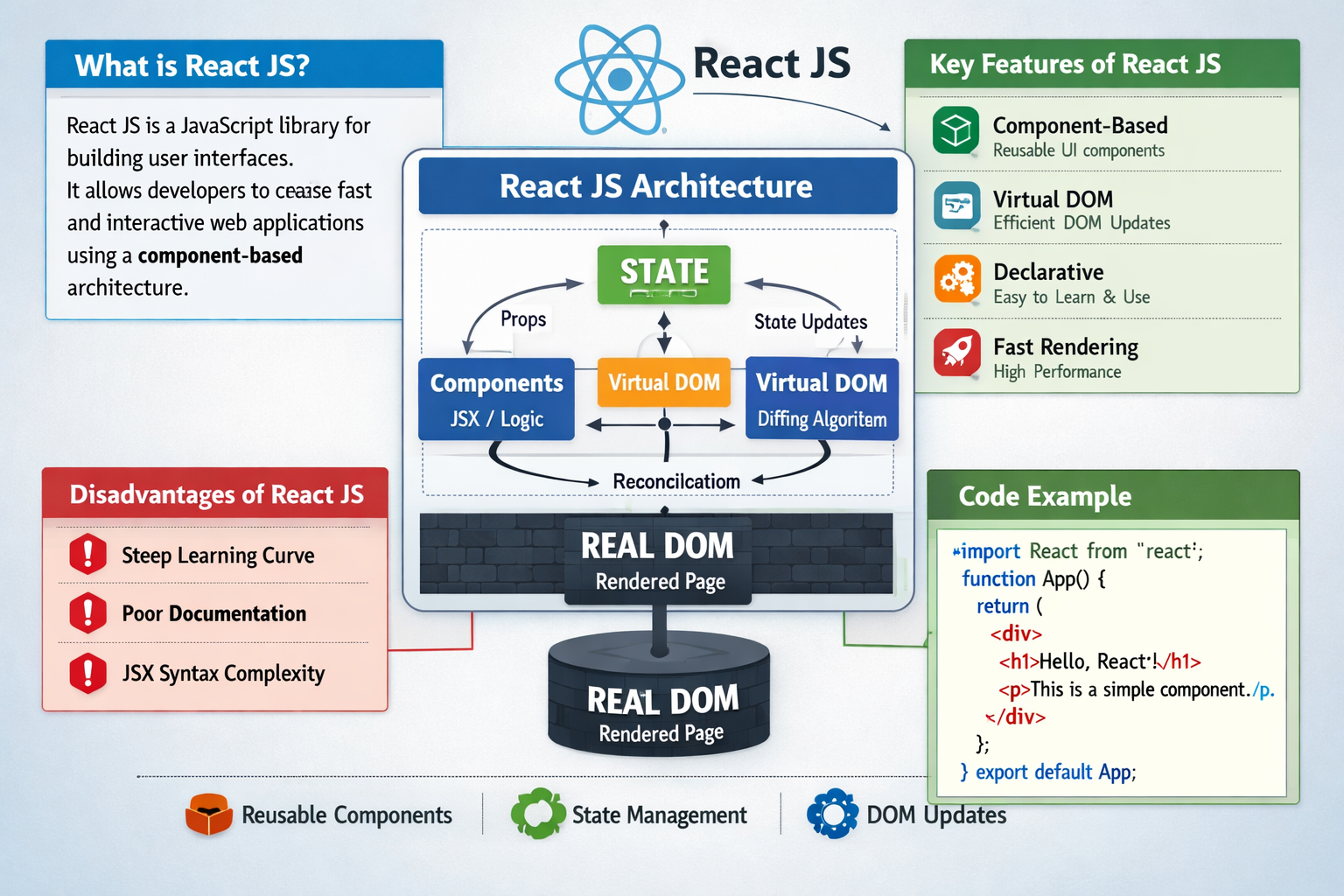
Code Example
import React from 'react';

                    function App() {
                      const [count, setCount] = React.useState(0);

                      return (
                        <div>
                          <h1>Hello, React!</h1>
                          <p>Count: {count}</p>
                          <button onClick={() => setCount(count + 1)}>
                            Increment
                          </button>
                        </div>
                      );
                    }

export default App;Key Takeaway
React JS is ideal for modern web development, especially when building scalable, interactive UIs. Focus first on components, JSX, and state management before diving into advanced topics like hooks and context.