
Angular JS Overview
A powerful, component-based JavaScript library for building modern, interactive user interfaces with efficiency and scalability.
What is Angular?
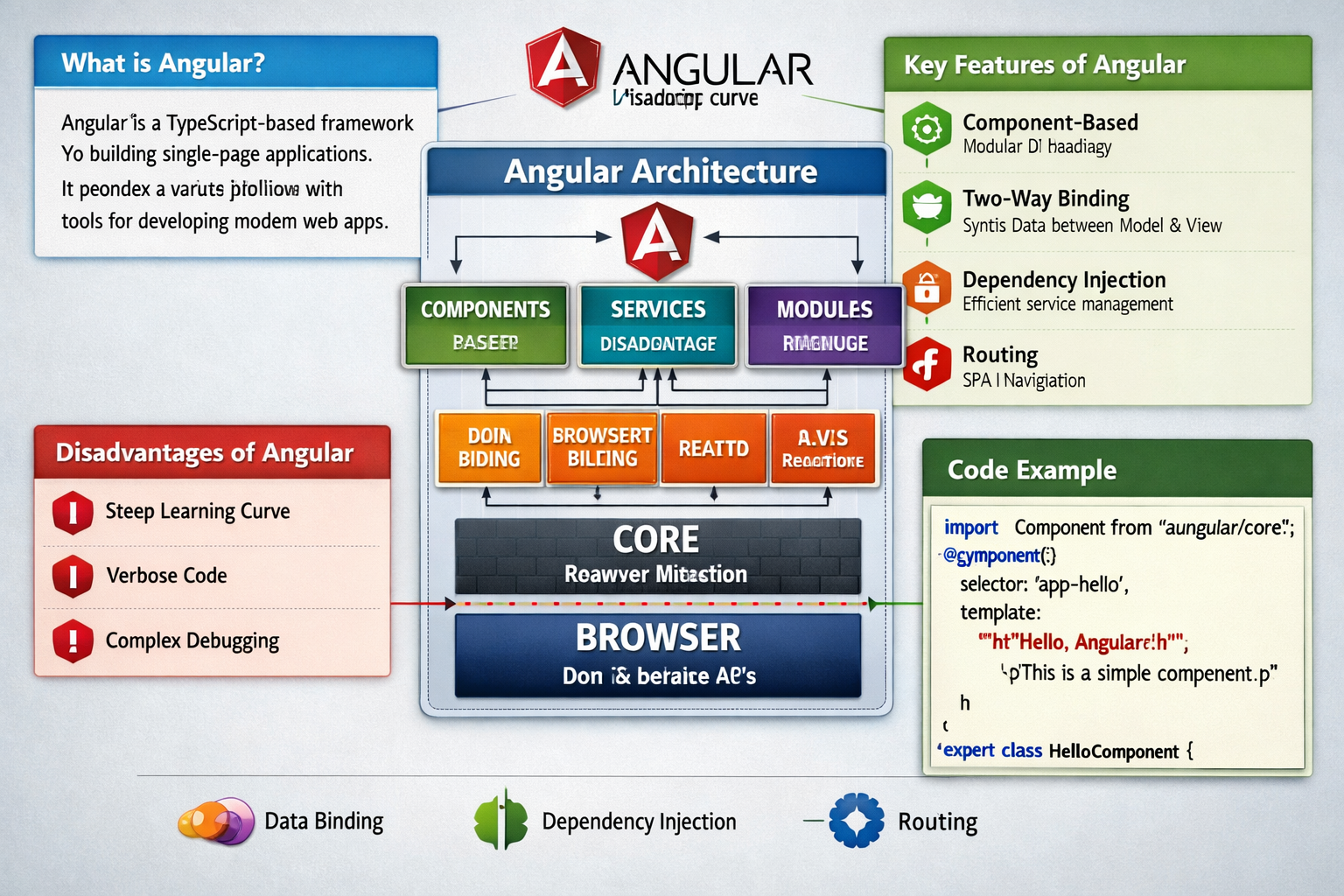
Angular is a TypeScript-based framework developed by Google for building single-page applications (SPAs). It provides a robust platform with tools for developing modern web apps, including routing, forms, HTTP client, and RxJS for reactive programming.
Key Features
- 1
Component-Based Architecture
Modular and reusable UI blocks with encapsulated styles and logic
- 2
Two-Way Data Binding
Automatically syncs data between model and view layers
- 3
Dependency Injection
Built-in DI system for efficient service management
- 4
Routing & Navigation
Powerful router for building SPAs with seamless navigation
- 5
RxJS Observables
Reactive programming for handling async operations elegantly
- 6
Built-in Tools
CLI, testing utilities, and form handling out of the box
Considerations
Steep Learning Curve
Requires understanding of RxJS, TypeScript, decorators, and DI
Verbose Code
Boilerplate-heavy approach can be overkill for small applications
Performance Overhead
Larger bundle sizes compared to lighter frameworks
Complex Debugging
Harder to trace errors in large, complex applications
Architecture Overview
Code Example
import { Component } from '@angular/core';

@Component({
  selector: 'app-hello',
  template: `
    <div>
      <h1>Hello, Angular!</h1>
      <p>Count: {{ count }}</p>
      <button (click)="incrementCount()">
        Increment
      </button>
    </div>
  `,
  styles: [`h1 { color: #3f51b5; }`]
})
export class HelloComponent {
  count = 0;
  incrementCount() { this.count++; }
}Key Takeaway
Angular is ideal for enterprise-level applications needing scalability, robust features, and maintainability. Focus on components, data binding, and services before diving into advanced topics like RxJS and NgModules.